Prism
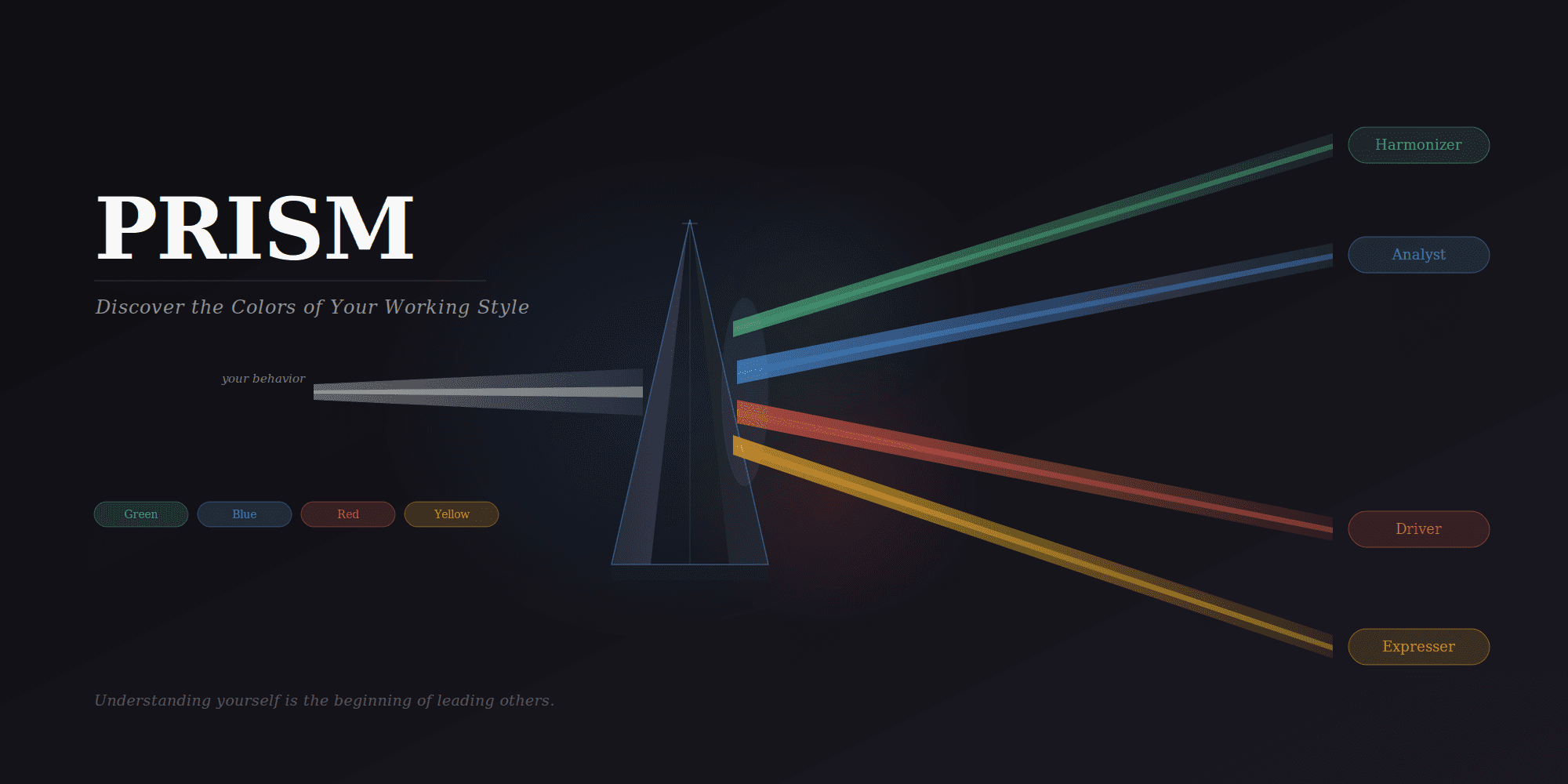
PRISM: Discover the Colors of Your Working Style
Four colors, a handful of questions, and — if you answer honestly — a genuinely fresh perspective on why you react the way you do at work and in life.
Most personality tools sort people into categories, slap on a label, and leave you with a description that's hard to act on. PRISM works differently. It doesn't tell you who you are — it tells you how you operate under pressure, in your natural environment, in professional relationships. And that distinction makes an enormous practical difference.
This article is a hands-on introduction to the PRISM methodology: what it is, where it comes from, how to read your results, and — most importantly — how to put that knowledge to work every day.
What Is PRISM?
PRISM Brain Mapping is a psychometric tool grounded in neuroscience — specifically in understanding how different areas of the brain influence our behavior. The name comes from the analogy of an optical prism: white light splits into its component colors. Your personality works the same way. It's made up of different behavioral "colors" that combine into a unique profile.
Unlike many personality assessments, PRISM distinguishes between natural behavior (how you act when there's no pressure and no one is watching) and adapted behavior (how you adjust to meet the expectations of your environment). The gap between these two layers is often where the most valuable insights live — and it answers the question of why we feel like a different person at work than we do at home.
"There is no good or bad PRISM profile. There are profiles that fit a given context — and profiles that don't."
The Four Colors — A Practical Guide
Each color represents a set of motivations, values, and typical behaviors. One important note: almost everyone carries all four colors. What differs is the proportion — not whether a color is present or absent.
🟢 Green — The Harmonizer
Empathetic, patient, loyal. Green is motivated by care for others and the need for stable relationships. In a team, they are the glue — smoothing conflicts, listening deeply, remembering the human side of every situation. Green builds trust more slowly than other styles, but once built, it lasts.
Thrives in: harmony, predictability, a sense of belonging. Struggles with: conflict, sudden change, competitive environments.
🔵 Blue — The Analyst
Precise, systematic, cautious. Blue is motivated by data and accuracy. Before making a decision, they want to understand all the variables. Quality and thoroughness are their core values — and they expect the same from others. Blue isn't afraid to say "I don't know yet," because getting it right matters more than getting it fast.
Thrives in: clear standards, time to analyze, the ability to refine details. Struggles with: improvisation, missing data, pressure to decide without sufficient information.
🔴 Red — The Driver
Decisive, direct, results-oriented. Red is motivated by control and achievement. They act fast, dislike unnecessary procedures, and value efficiency over consensus. Red sees the goal and instinctively asks: "what's in the way, and how do we remove it?" In meetings, they often push to close discussions — the decision feels obvious to them, even when others aren't there yet.
Thrives in: autonomy, pace, measurable results, challenge. Struggles with: excessive process, lack of influence, slow-moving environments.
🟡 Yellow — The Expresser
Enthusiastic, creative, sociable. Yellow is motivated by recognition and self-expression. They think in big pictures, are naturally infectious with energy, and spontaneously build bridges between people and ideas. Yellow often has the best idea in the room — and may need support from a more structured partner to actually see it through.
Thrives in: variety, creative freedom, visibility, human connection. Struggles with: routine, isolation, excessive detail and control.
How to Read Your Results
When you receive your profile, you'll see a distribution of the four colors — usually expressed as percentages or as a count of responses. Here's how to approach the interpretation:
Step 1 — Find your dominant color. The highest-scoring color describes your natural default mode: how you react under stress, how you make instinctive decisions, and what you need to feel good at work.
Step 2 — Look at the configuration, not just the leader. A green-yellow profile is something entirely different from a green-blue one, even if both have green on top. Your second-strongest color significantly shapes your operating style — it influences your pace, your priorities, and the way you communicate.
Step 3 — Notice your lowest color. The color with the lowest score isn't a weakness — it's simply an area where you operate less frequently and with less natural energy. In some roles this is entirely neutral. In others, it can create blind spots worth paying attention to.
Step 4 — Map it against your professional context. Ask yourself: what behaviors does my role actually require? Where does my profile work in my favor — and where do I have to consciously invest extra energy? This question matters more than the score itself.
A practical note: shorter versions of the test (8–12 questions) give a useful directional picture of your dominant colors. They're a good starting point for reflection, but they don't replace a full assessment — especially in a professional or coaching context.
Common Combinations Worth Knowing
The pairing of your two strongest colors often tells you more than the dominant color alone. A few common configurations:
Red + Blue — Fast decisions backed by data. A natural operational leader, effective in environments that demand both execution and precision. Watch out for: overlooking the human factor, difficulty slowing down to truly listen.
Green + Yellow — Builds authentic relationships, leads through atmosphere and warmth. An excellent mentor and transformational leader. Watch out for: avoiding difficult conversations, delaying decisions in the name of harmony.
Blue + Green — Attentive, reliable, consistent. Cares equally about quality and people. Watch out for: decisions that take too long, discomfort with ambiguity and open-ended situations.
Yellow + Red — Energetic, visionary, persuasive. A natural champion of new ideas and change. Watch out for: losing track of details and follow-through, difficulty working within constraints.
Green + Blue — An empathetic analyst. Builds trust through competence and consistency. Watch out for: difficulty with visibility and self-promotion — their work speaks quietly, even when it should speak loudly.
How to Put This Into Practice
Working with yourself
The most valuable question after taking the test isn't "what color am I?" — it's: in which situations does my profile work for me, and in which does it cost me extra effort? This isn't an invitation to fix yourself. It's a map of the terrain you navigate every day.
If your dominant color is blue, you naturally avoid situations where data is missing and control feels out of reach. Knowing this, you can consciously build "certainty rituals" — a quick review of the key numbers before an important meeting, rather than walking in with a vague sense of unease.
If green dominates, you may notice you put off difficult conversations far too long. Simply recognizing that pattern — without judging it — gives you the awareness to act sooner when the situation demands it.
In relationships with others
PRISM is a remarkably useful tool for understanding why someone's working style frustrates you. A red charging ahead to a decision irritates a blue who hasn't finished analyzing. A green who wants to process feelings exasperates a red who considers that a detour. This isn't a personality flaw on either side — it's a difference in how the brain processes information and decides what matters.
A practical exercise: before entering a difficult conversation with someone who has a different profile, ask yourself — what does this person need in order to feel heard and safe in this conversation? Red needs specifics and respect for their time. Green needs you not to bulldoze. Blue wants data and space to ask questions. Yellow needs to feel seen, not just listened to.
Building a team
One of the most powerful applications of PRISM is thinking deliberately about complementarity. Homogeneous team profiles — say, everyone is analytical — perform brilliantly under certain conditions and fall apart in others. A team that spans different colors, and understands its own differences, is dramatically more resilient and creative.
As a leader, it's worth knowing not just your own profile, but which colors are underrepresented on your team. Not to "hire by color," but to recognize which perspectives you need to actively seek out — because no one will bring them naturally.
Managing your own career
PRISM can help answer one of the hardest career questions: why does this role exhaust me, even though I'm good at it? Often the answer lies here — the role requires you to operate against your natural profile, day after day. That's not a reason to quit, but it is a reason to understand the cost and manage it consciously.
What PRISM Is Not
It's worth ending with a few caveats, because tools like this are easy to misuse.
PRISM is not a verdict. A profile describes tendencies, not fixed behavior. People with identical color distributions can live and work in completely different ways — because experience, values, and self-awareness all matter enormously.
PRISM should not be used to box people in. "She's green, so she can't lead" is a mistake. Every color has its own leadership style and its own strengths in that role.
PRISM does not replace conversation. A test result is a starting point for reflection, not a ready-made answer. The most valuable insights emerge when you test your result against reality — against feedback from others, against specific situations from your own life, alongside a coach or mentor. For more on coaching as a discipline, see Coaching for Performance and the foundational ideas behind it in The Inner Game.
A Final Thought
If I were to suggest one exercise after reading this article, it wouldn't be "go take the test." It would be this: recall three recent situations where you reacted in a way that surprised you — or surprised someone else. Consider which color was at the wheel in that moment. And ask yourself whether that was the color you wanted there.
Self-awareness isn't a weekend project. But PRISM can be a surprisingly good place to start.
Related Posts
Coaching for performance
"Coaching for Performance" by Sir John Whitmore is one of the top 5 professional books I have read recently.
Book review: Become an Effective Software Engineering Manager
Insights from becoming an effective software engineering manager - transitioning from individual contributor to leadership.
Inner game
Our Performance equals our potential minus interference
The Lombardi Rules: 26 Lessons from Vince Lombardi
If you've ever wondered what separates good leaders from truly great ones, The Lombardi Rules reveals the philosophy behind the legendary NFL coach who transformed the Green Bay Packers into a dynasty.