Book review: Secrets of Dynamic Communications by Ken Davis
Book review: Secrets of Dynamic Communications by Ken Davis
Following are notes I took while reading Ken Davis's Secrets of Dynamic Communications.
Many presentations fail before the speaker enters the room.
The slides may be polished. The speaker may know the subject well. There may be useful facts, good stories, and plenty of energy. But the message still feels difficult to follow because nobody made the hard decision about what the audience should understand or do.
That is the problem Ken Davis addresses. His argument is simple: effective communication begins with focus. Delivery matters, but confidence, humor, and stage presence cannot rescue a message that has no clear destination.
The most useful part of the book is the SCORRE method, a framework for turning a broad subject into a focused presentation. It is practical, demanding, and more relevant than its public-speaking label might suggest. The same discipline can improve a keynote, a sales pitch, a team update, a workshop, or an important conversation.
What Stayed With Me Most
What stayed with me most is the idea that communication needs an objective before it needs more content.
When preparing a presentation, it is tempting to begin by collecting material. We add examples, statistics, slides, quotations, and stories. The presentation grows, but its purpose often becomes less visible. We are producing content before deciding what that content is meant to achieve.
SCORRE reverses that order. It forces the speaker to narrow the message and identify its destination. Only then do the supporting points and illustrations earn their place.
This is why I found the framework valuable. It does not mainly help you say more. It helps you remove what does not serve the message.
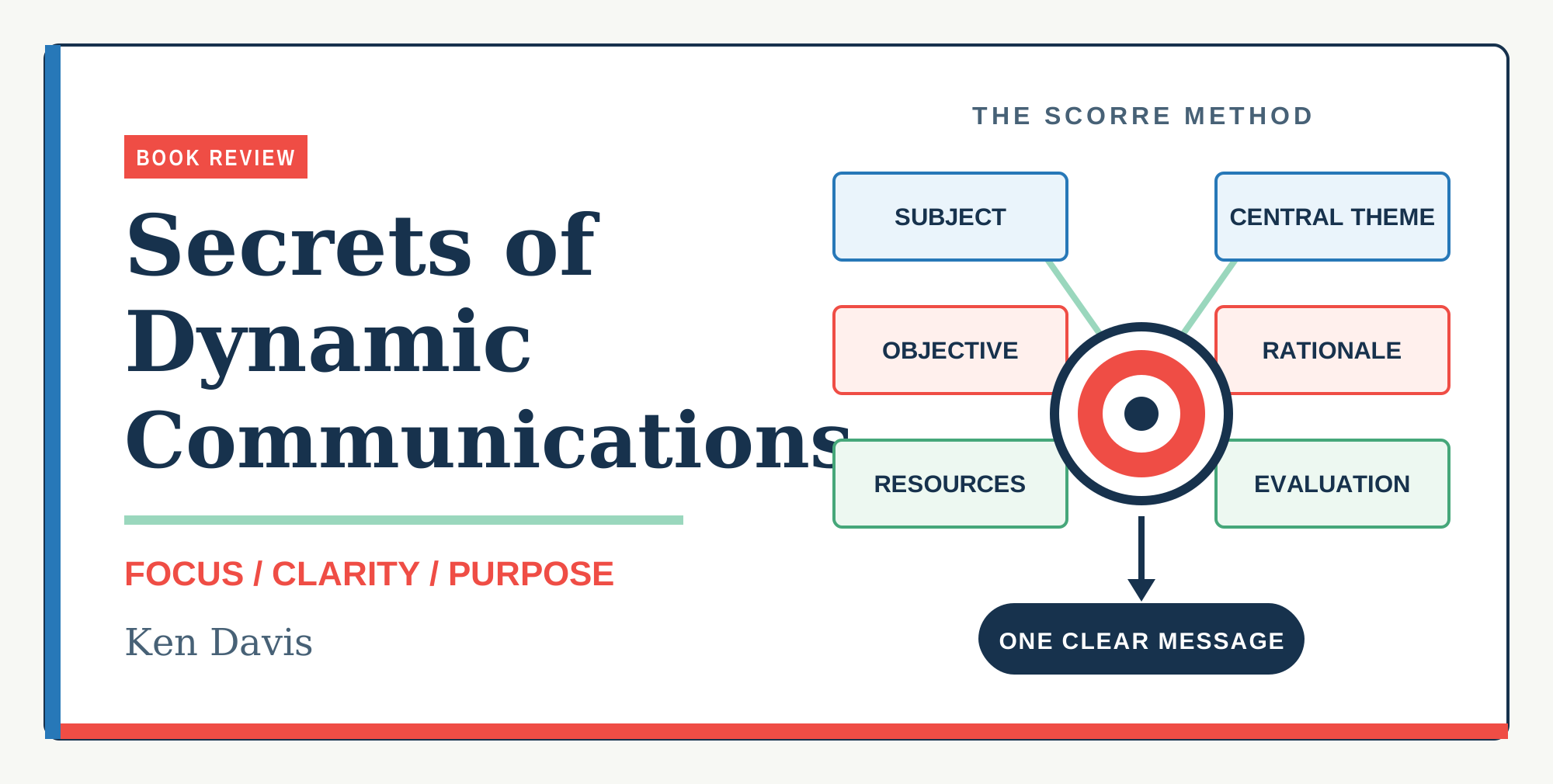
The SCORRE Method
SCORRE stands for:
- Subject: the broad area you want to address.
- Central Theme: the specific part of that subject you will discuss.
- Objective: the precise result the presentation should produce.
- Rationale: the main points that logically support the objective.
- Resources: the stories, evidence, examples, and illustrations that clarify those points.
- Evaluation: the final check that every part of the presentation leads toward the objective.
The sequence matters.
A subject such as sales, relationships, or swimming is too broad to guide a useful presentation. A central theme narrows the territory, but the objective tells the presentation where to go. The rationale creates the route. Resources make that route understandable and memorable. Evaluation checks whether the pieces actually belong together.
Without this order, resources can take over. A strong anecdote stays in the presentation because it is entertaining, even if it does not support the point. A slide remains because it took time to create. An interesting detail receives attention because the speaker likes it, not because the audience needs it.
SCORRE makes focus a design constraint. Every element has to justify its presence.
The Objective Sentence
The objective sentence is the part of the framework I found most important.
Davis distinguishes between two kinds of propositions: persuasive and enabling. Both create a clear destination, but they serve different purposes.
A persuasive proposition argues that someone should believe or do something. It is answered with why.
An enabling proposition shows that someone can do something. It is answered with how.
The distinction looks small, but it changes the whole presentation. If the audience is not convinced that an action matters, they need reasons. If they already accept its value but do not know how to proceed, they need a method.
Confusing these two objectives creates frustrating communication. A speaker may spend twenty minutes explaining how to do something the audience has no desire to attempt. Or they may spend the entire presentation proving that a change is necessary without giving people a practical way to make it.
Persuasive and Enabling Examples
The formula becomes clearer when the same subject is approached from both directions.
Swimming
Persuasive proposition: Every adult should learn to swim because of three important benefits.
This presentation answers why. Its main points might cover personal safety, confidence around water, and access to a useful form of exercise.
Enabling proposition: Every adult can learn to swim by following four progressive steps.
This presentation answers how. Its main points might cover becoming comfortable in the water, learning to breathe, practising buoyancy, and coordinating basic strokes.
The subject is the same, but the audience need is different. One talk creates motivation; the other creates capability.
Relationships
Persuasive proposition: Every person should invest deliberately in close relationships because of the benefits they bring.
The rationale could explore emotional support, honest perspective, and resilience during difficult periods.
Enabling proposition: Every person can strengthen close relationships by practising three habits.
The presentation could then focus on listening without preparing a response, making time consistently, and addressing tension before it becomes resentment.
Again, one objective builds conviction. The other provides a path.
Sales
Persuasive proposition: Every professional should learn effective sales skills because of the opportunities they create.
The rationale might include understanding customer needs, communicating value clearly, and gaining support for worthwhile ideas. This framing also makes an important point: selling is not limited to people with "sales" in their job title.
Enabling proposition: Every professional can become more effective at selling by applying three customer-focused principles.
The main points could be asking better questions, connecting the offer to a real problem, and making the next step clear.
These examples show why writing the proposition is not a cosmetic exercise. It determines what belongs in the presentation and what does not.
Why SCORRE Matters
The greatest value of SCORRE is not the acronym itself. It is the thinking the acronym requires.
First, it respects the audience's attention. A focused message is easier to follow because listeners do not have to discover the point for themselves.
Second, it exposes weak thinking. If you cannot state the objective clearly, adding slides will not solve the problem. The difficulty may be in the idea, not the delivery.
Third, it makes editing less personal. Instead of asking whether a story is good, you can ask whether it supports the objective. Instead of debating whether a section is interesting, you can ask whether it advances the rationale.
Finally, it separates explanation from persuasion. That distinction is useful well beyond formal presentations. Leaders regularly need to decide whether people lack motivation, understanding, or practical ability. Those are different communication problems and should not receive the same message.
The Role of Humor
Davis also gives humor an important place in effective communication. Not because every speaker needs to become a comedian, but because humor can reduce distance between the speaker and the audience.
Used well, humor helps people relax, pay attention, and become more receptive to an idea. It can make a difficult subject easier to approach and give the audience a memorable way to hold on to the message. A speaker who can laugh at their own mistakes also appears more human and less interested in performing authority.
But humor still has to serve the objective. A funny story that does not clarify the rationale is a detour, no matter how well it works in the room. The audience may remember the joke and forget the point.
This is where humor fits naturally into the Resources part of SCORRE. It can add color to an argument, illustrate a principle, or create a moment of relief, but it should not compete with the message. The safest humor usually grows from shared experience, observation, or the speaker's own shortcomings rather than making someone else the target.
The useful question is not simply, "Will this make people laugh?" It is, "Will this help people receive and remember what I am trying to communicate?"
Where the Method Feels Rigid
SCORRE can initially feel mechanical.
The proposition formulas, key words, parallel rationale, and evaluation questions may seem restrictive, especially to someone who prefers to develop ideas through writing or speaking freely. There is also a risk of treating the worksheet as a guarantee that the presentation will be engaging. Structure alone does not create warmth, judgment, or connection with an audience.
But I do not think the rigidity is a flaw. It is closer to scaffolding.
The method makes the preparation process slower at the point where many of us want to move quickly: defining the objective. In exchange, it makes the rest of the work more deliberate. Once the structure is sound, the speaker still has room for stories, personality, humor, and spontaneity.
Constraint is useful when it protects clarity.
My Takeaways
My main takeaway is that a presentation should be built around one change in the audience, not around everything the speaker knows.
I also like the practical difference between should and can:
- Use a persuasive proposition when the audience needs a reason to care.
- Use an enabling proposition when the audience needs a way forward.
- Do not assume that convincing people and equipping them are the same task.
The framework also offers a useful editing question: if this slide, example, or story disappeared, would the objective become harder to reach? If not, it may not belong.
That is a demanding standard, but it is a healthy one.
Who Should Read This Book
This book is useful for speakers, trainers, consultants, managers, sales professionals, teachers, and anyone who regularly needs to make complex ideas understandable.
It is especially valuable for people who know their subject well but struggle to reduce it to a focused message. Expertise often creates the urge to include everything. SCORRE provides a disciplined way to decide what the audience actually needs now.
Final Thoughts
Secrets of Dynamic Communications is a practical book about preparation before it is a book about performance.
Its strongest contribution is the reminder that clarity is designed. A focused presentation does not emerge from adding enough good material. It emerges from choosing an objective, building a logical path toward it, and removing whatever leads elsewhere.
SCORRE may look like a simple worksheet, but the habit underneath it is substantial: know what you are talking about, know what you want to accomplish, and make every part of the message serve that purpose.
If you are interested in related ideas about leadership and helping people move forward, I would pair this with Coaching for Performance, Become an Effective Software Engineering Manager, and The Five Dysfunctions of a Team.
Related Posts
Coaching for performance
"Coaching for Performance" by Sir John Whitmore is one of the top 5 professional books I have read recently.
Book review: Become an Effective Software Engineering Manager
Insights from becoming an effective software engineering manager - transitioning from individual contributor to leadership.
The Five Dysfunctions of a Team by Patrick Lencioni
Notes from Patrick Lencioni's book about trust, productive conflict, commitment, peer accountability, and shared results.
The Lombardi Rules: 26 Lessons from Vince Lombardi
If you've ever wondered what separates good leaders from truly great ones, The Lombardi Rules reveals the philosophy behind the legendary NFL coach who transformed the Green Bay Packers into a dynasty.
Eat That Frog! by Brian Tracy
Your ability to select your most important task at each moment, and then to get started on that task and to get it done both quickly and well, will probably have more of an impact on your success than any other quality or skill you can develop.
Book review: Genius Makers
An exceptionally well written book about the origins of AI