The Five Dysfunctions of a Team by Patrick Lencioni
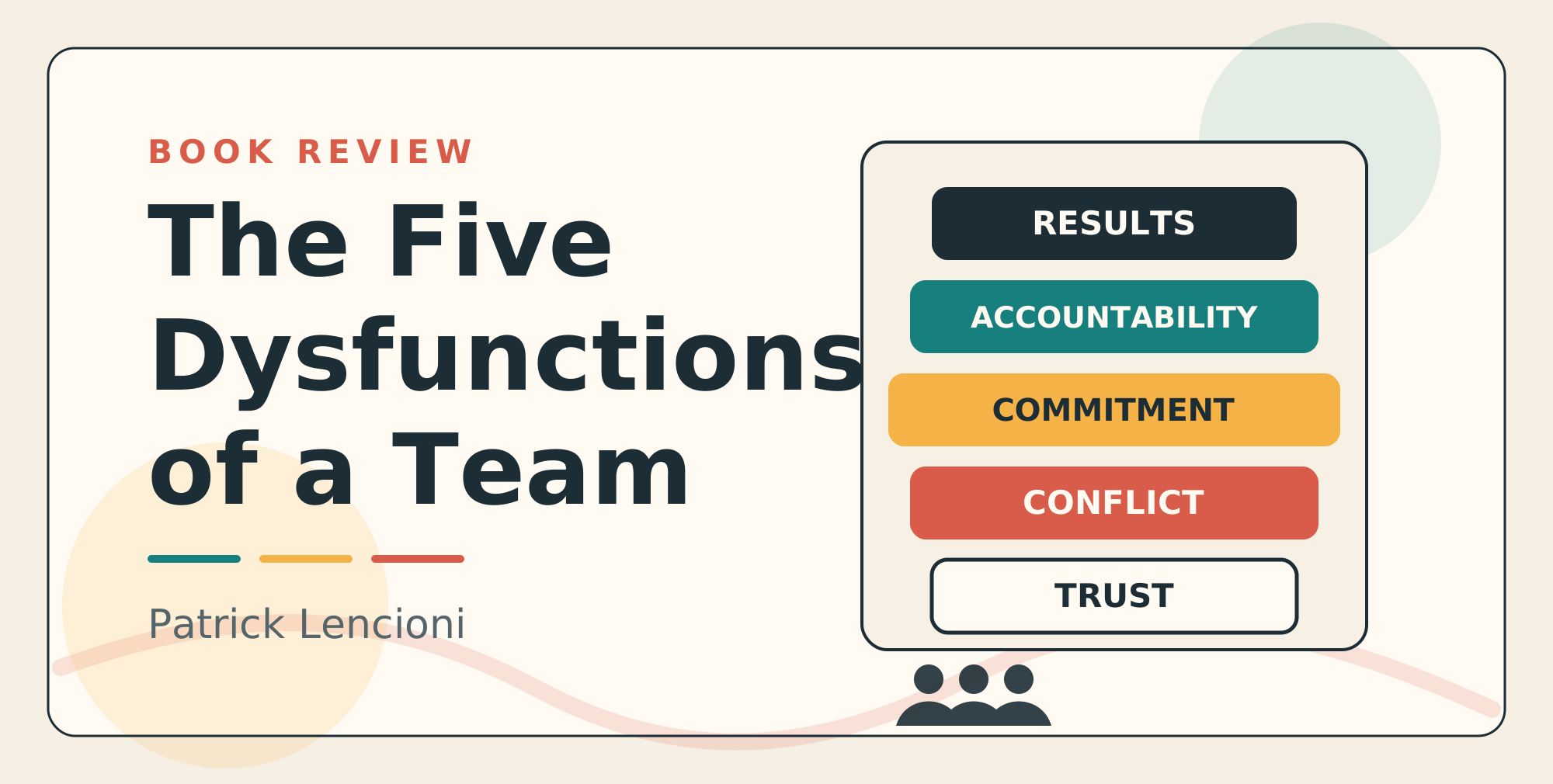
The Five Dysfunctions of a Team — Patrick Lencioni
Following are notes I took while reading Patrick Lencioni's The Five Dysfunctions of a Team.
The thing that stayed with me most is this: teams rarely fall apart in a dramatic way. More often, they decay politely.
People stop saying what they really think. Meetings stay calm, but the real conversation moves elsewhere. Decisions are made, but not truly owned. Everyone remains professional, and yet the team slowly loses the ability to think together.
That is why this book is useful. At first glance the model looks almost too simple. Trust, conflict, commitment, accountability, results — nothing surprising. But the longer I sat with it, the more uncomfortable it became in a useful way. It does not let you hide behind process, tooling, strategy decks, or clever management vocabulary. It keeps returning to one question: can this group of people actually work together when it matters?
Patrick Lencioni presents the model through a fictional story about a struggling executive team. A new CEO joins the company and slowly uncovers the real problem: the team is not failing because people are unintelligent or lazy. It is failing because the human system underneath the work is broken. People avoid vulnerability, avoid conflict, leave meetings without real commitment, hesitate to hold each other accountable, and eventually protect their own area more than the collective result.
That is the strength of the book. It gives a simple language for problems most teams can feel long before they can name them.
The Five Dysfunctions
Lencioni describes the dysfunctions as a pyramid:
- Absence of trust
- Fear of conflict
- Lack of commitment
- Avoidance of accountability
- Inattention to results
The order matters. If people do not trust each other, they will not say what they really think. If they do not say what they really think, commitment becomes shallow. If commitment is shallow, accountability feels awkward or political. And if accountability is weak, personal agendas quietly become more important than team results.
That is enough of the model. The interesting part is what it reveals about real teams.
What Stayed With Me Most
The chapter that stayed with me the most was the one about managing conflict consciously.
Healthy conflict is not about being loud, aggressive, or constantly debating everything. It is about creating enough trust that people can disagree directly and still remain on the same side. A team that avoids conflict often looks mature from a distance. People are calm. Meetings are polite. Nobody interrupts. But underneath that calm there may be unspoken tension, private frustration, and decisions that nobody truly owns.
Lencioni makes an important distinction here: the opposite of destructive conflict is not silence. It is productive conflict. The team needs the ability to enter difficult topics while they are still manageable, before they turn into resentment or passive resistance.
I have seen this pattern in teams: the meeting ends with apparent agreement, but the disagreement was never actually resolved. It was only postponed. Later it comes back as slow execution, side conversations, or a quiet lack of ownership. That is much more expensive than a difficult conversation held early.
This connects strongly with leadership work. A leader does not need to manufacture drama, but they do need to make disagreement discussable. When someone raises a difficult point, the leader's reaction teaches the room what is allowed. If the leader becomes defensive, changes the topic, or rewards harmony over honesty, the team learns quickly. If the leader can stay present, curious, and firm, conflict becomes a tool for clarity rather than a personal attack.
Accountability Is Peer Pressure in the Best Sense
Another section I found especially practical is the fourth dysfunction: avoidance of accountability.
The book includes an exercise where team members answer two questions about each person, excluding themselves:
- What is the one most important quality this person has that contributes to the team's effectiveness?
- What is the one most important quality this person has that can sometimes reduce the team's effectiveness?
I like this exercise because it is simple, direct, and difficult to fake. It avoids the vague language of many feedback processes. It asks people to name both the contribution and the cost of working with each other.
The deeper idea is that the strongest accountability in a team does not always come from the leader. It comes from peers who respect each other enough to speak up. In a healthy team, people do not only wait for a manager to correct behavior or performance. They care enough about the shared result to challenge one another.
That said, Lencioni is careful about the leader's role. Peer accountability does not appear by magic. The leader has to model it first. If the leader avoids hard conversations, the team will avoid them too. If the leader can give clear feedback without humiliation, and receive feedback without defensiveness, the team gets permission to do the same.
This is one of the most useful leadership reminders in the book: accountability is cultural before it is procedural. You can create rituals, scorecards, reviews, and operating cadences, but if people are afraid to tell the truth, the process becomes theatre.
Why This Matters for Real Teams
What I appreciate about the model is that it makes team health observable. You can look at a team and ask:
- Do people admit mistakes and weaknesses openly?
- Do meetings include real disagreement, or only status reporting?
- Do people leave discussions knowing exactly what was decided?
- Do team members challenge each other directly when commitments slip?
- Are shared results more important than individual comfort or local optimization?
These questions are uncomfortable because they remove abstraction. A team can have great tooling, a modern delivery process, and intelligent people, while still failing at these basics.
The diagnostic pages in the book are also valuable because they make the model concrete. Statements like "team members openly discuss weaknesses and mistakes" or "meetings are compelling rather than boring" are easy to react to. You can quickly see where a team is strong and where it is quietly compensating.
My Takeaways
The main lesson for me is that team effectiveness is not only a coordination problem. It is also a trust problem, a conflict problem, a commitment problem, and an accountability problem.
The book also reminded me that harmony is not the same as health. Sometimes a quiet team is aligned. Sometimes it is just avoiding the truth. The difference shows up later, when decisions need ownership and people need to challenge each other without waiting for permission.
I also like how practical the book is. The exercises are not complicated. They require courage more than sophistication. That is probably why they work. Ask people what helps the team. Ask what hurts the team. Make commitments explicit. Return to results. Repeat until the culture changes.
Who Should Read This Book
This is a strong read for managers, team leads, founders, product leaders, and anyone whose work depends on honest collaboration.
It is especially useful if your team is full of capable people but still struggles with slow decisions, passive agreement, weak ownership, recurring tension, or meetings that feel busy but strangely unproductive.
Final Thoughts
The Five Dysfunctions of a Team is not a complex book, and that is part of its value. It gives leaders and teams a shared vocabulary for problems that are easy to feel but hard to name.
For me, the strongest message is this: the best teams are not the ones without conflict. They are the ones that can use conflict consciously, commit clearly, and hold each other accountable without turning the work into politics.
If you are interested in related leadership ideas, I would pair this with Coaching for Performance, PRISM, and Become an Effective Software Engineering Manager.
Related Posts
Coaching for performance
"Coaching for Performance" by Sir John Whitmore is one of the top 5 professional books I have read recently.
Book review: Become an Effective Software Engineering Manager
Insights from becoming an effective software engineering manager - transitioning from individual contributor to leadership.
Prism
Most personality tools give you a label. PRISM gives you a mirror — one that shows how you think, decide, and lead when it counts.
Book review: Secrets of Dynamic Communications by Ken Davis
Notes from Ken Davis's practical guide to focused communication, the SCORRE method, and building persuasive or enabling presentations around one clear objective.
The Lombardi Rules: 26 Lessons from Vince Lombardi
If you've ever wondered what separates good leaders from truly great ones, The Lombardi Rules reveals the philosophy behind the legendary NFL coach who transformed the Green Bay Packers into a dynasty.
Eat That Frog! by Brian Tracy
Your ability to select your most important task at each moment, and then to get started on that task and to get it done both quickly and well, will probably have more of an impact on your success than any other quality or skill you can develop.